Enter the query into the form above. You can look for specific version of a package by using @ symbol like this: gcc@10.
API method:
GET /api/packages?search=hello&page=1&limit=20
where search is your query, page is a page number and limit is a number of items on a single page. Pagination information (such as a number of pages and etc) is returned
in response headers.
If you'd like to join our channel search send a patch to ~whereiseveryone/toys@lists.sr.ht adding your channel as an entry in channels.scm.
Utilities to package up Haskell functions and values into a Lua module. . This package is part of HsLua, a Haskell framework built around the embeddable scripting language <https://lua.org Lua>.
inline-c lets you seamlessly call C libraries and embed high-performance inline C code in Haskell modules. Haskell and C can be freely intermixed in the same source file, and data passed to and from code in either language with minimal overhead. No FFI required.
This package provides a Haskell library for setting environment variables.
This package provides a commutative semigroup is a semigroup where the order of arguments to mappend does not matter.
This package provides a version of ghc-hspec-expectations generalized to MonadIO.
Provides a small set of helper functions for testing Megaparsec parsers with Hspec.
This package defines classes of monads that can perform multiple executions in parallel and combine their results. For any monad that's an instance of the class, the package re-implements a subset of the Control.Monad interface, but with parallel execution.
This package provides a dependent sum is a generalization of a particular way of thinking about the Either type. Either a b can be thought of as a 2-tuple (tag, value), where the value of the tag determines the type of the value. In particular, either tag = Left and value :: a or tag = Right and value :: b. This package allows you to define your own dependent sum types by using your own "tag" types.
This package includes Hakell modules providing various helper functions for Lists, Maybes, Tuples, Functions.
This package provides instances for QuickCheck's \"Arbitrary\" typeclass.
This package contains a MonadRef type class that abstracts over the details of manipulating references, allowing one to write code that can operate in either the ST monad or the IO monad.
Reading of directory contents in constant memory, i.e. in an iterative fashion without storing all directory elements in memory. From another perspective, this reading interface allows stopping at any point without loading every directory element. Also defines general-purpose recursive directory traversals. Both Windows and Unix systems are supported.
This library provides core modules of a markup combinator library for Haskell.
This package contains a wrapped name module for TimeLocale.
This package exposes combinators that can wrap arbitrary monadic actions. They run the action and potentially retry running it with some configurable delay for a configurable number of times. The purpose is to make it easier to work with IO and especially network IO actions that often experience temporary failure and warrant retrying of the original action. For example, a database query may time out for a while, in which case we should hang back for a bit and retry the query instead of simply raising an exception.
This package is an enhancement of the Text.Regex library, providing the PCRE backend to accompany regex-base, with bundled code from https://www.pcre.org.
This Haskell package provides the core MonadUnliftIO typeclass, a number of common instances, and a collection of common functions working with it.
This package provides a library for parsing and evaluating typst syntax. Typst (<https://typst.app>) is a document layout and formatting language. This library targets typst 0.13 and currently offers only partial support.
This package provides a Haskell library for working with base16-encoded data quickly and efficiently, using the ByteString type.
The mockery package provides support functions for automated testing.
This library provides Comonads for Haskell.
__This package is deprecated__. Please, use genByteString from the [random package (version >=1.2)](https://hackage.haskell.org/package/random) instead. . Efficient generation of random bytestrings. The implementation populates uninitialized memory with uniformily distributed random 64 bit words (and 8 bit words for remaining bytes at the end of the bytestring). . Random words are generated using the PRNG from the [mwc-random](https://hackage.haskell.org/package/mwc-random) package or the [pcg-random](https://hackage.haskell.org/package/pcg-random) package. It is also possible to use a custom PRNG by providing an instance for the RandomWords type class and using the function generate from the module "Data.ByteString.Random.Internal". . The generated byte strings are suitable for statistical applications. They are /not/ suitable for cryptographic applications. . 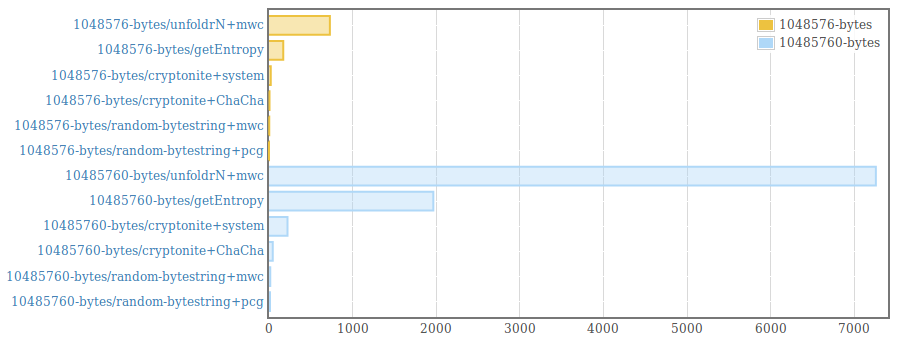 . 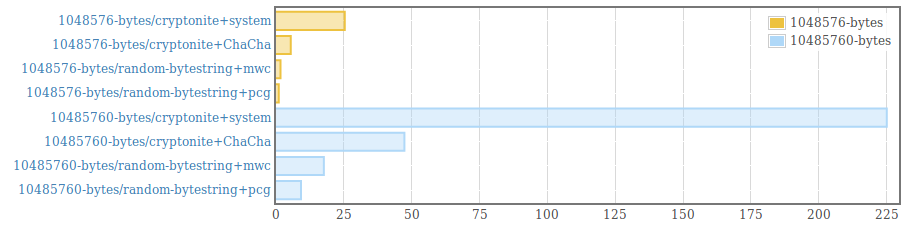
Provides an efficient Haskell implementation of Peano numbers
This package provides ordered containers of intervals, with efficient search for all keys containing a point or overlapping an interval. See the example code on the home page for a quick introduction.